|
|
I've been having problems with contamination of my tungsten, which is 2% lanthanated. I'm running 100% argon @ 15 cfh. Cup size 8-10. Welding CS with ER70s as well as 304 w/ 308 fillers, both with similar problems. I'm using a Primeweld 225 with the CK17 torch, both of which are fairly new.
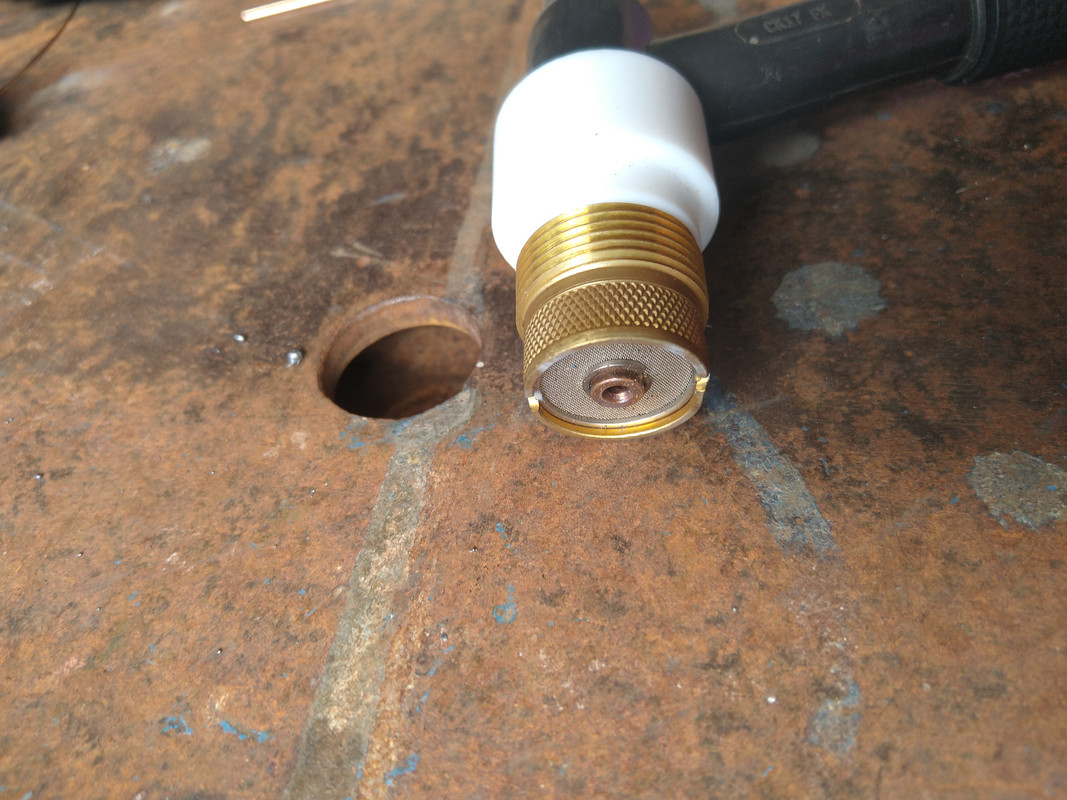
Here's the gas diffuser
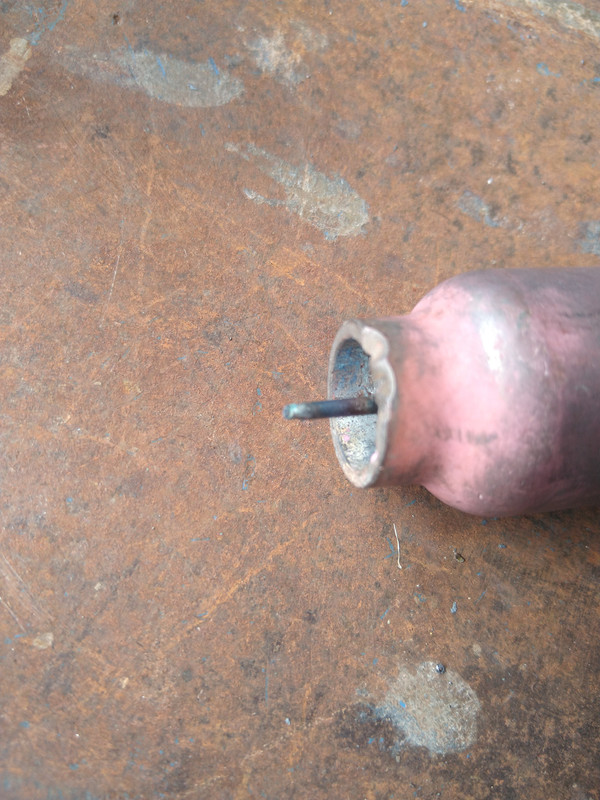
Here's the 3/32 tungsten stickout. The cup has seen better days, but is serviceable AFIAK
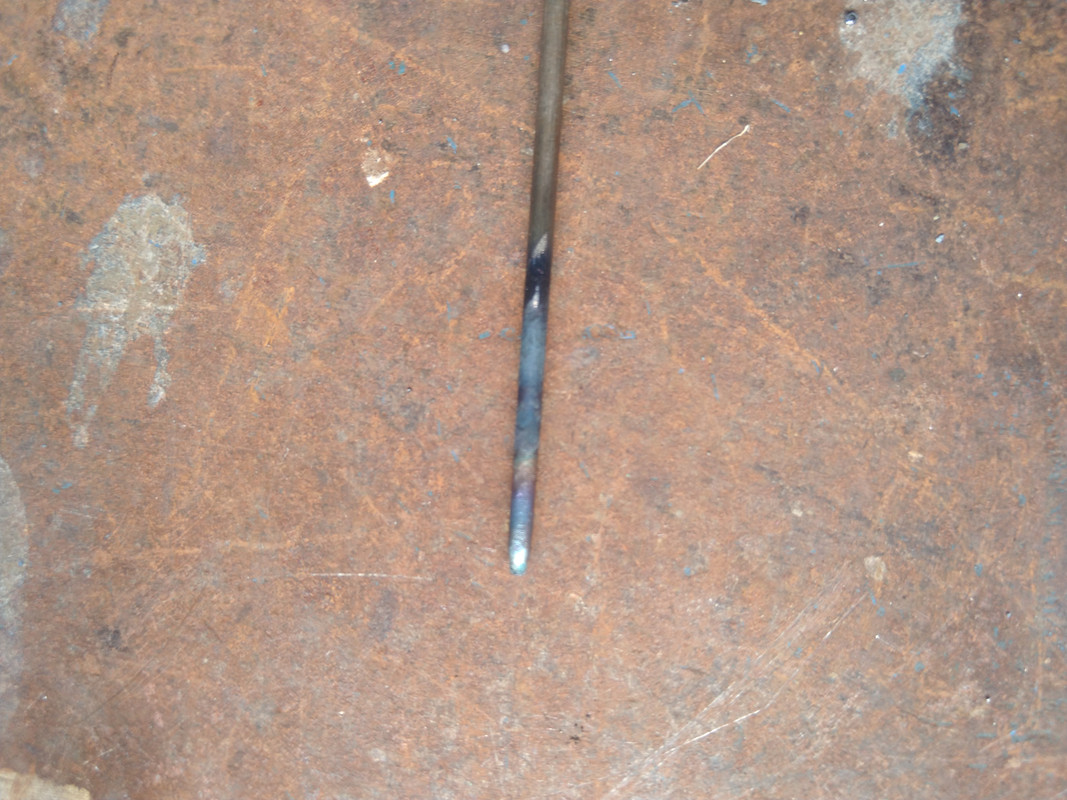
Here's the tungsten showing contamination.I can understand contamination at the tip, but am surprised that there's contamination where it sits inside the diffuser. It builds up so that it is hard, but not too hard, to pull out for sharpening. I've made the mistake of removing some of that buildup on the grinder wheel used for sharpening. I see now that once that part becomes near the taper it'll cause problems, so won't do that anymore.These pics are taken after welding for 5 minutes or so. Arc starts out alright, but then becomes unstable as contamination gets worse. Occasionally I'll get too close to the puddle or the filler, but don't recall that happening before these pictures. No matter what I do, I start getting a ball, or more really a flat mushroom on the tip. I'm starting out with a typical taper and a flat at the tip.I weld in my garage, and get similar results whether the door is open or closed. I don't weld if I'm in a breeze.Last edited by timsch; 2 Weeks Ago at 10:11 PM.Reason: wrong tungsten info
Reply:Remove the collet to see if the individual slit parts are crushed and/or twisted. Remove the back-cap to see if the O-ring is still in good shape.

1st on WeldingWeb to have a scrolling sig!

Reply:Do you have sufficient post flow (and are you waiting for it)?What welding current was used with that 2.4mm tungsten?Was that one dipped or tapped?JackLast edited by Jack Ryan; 2 Weeks Ago at 10:27 PM.
Reply:Looks to me like you might be welding dirty material you need to grind the material shinny and then wipe it with acetone or something similar. Ive had this happen before when trying to rush a job and not prepping the material properly TIG welding needs absolutely clean material to run right. Otherwise the oxides from what your welding will plate the tungsten. Also check your polarity, I recommend using 2% Thoriated tungstens on steel and stainless, it holds a point and doesnt ball. Definitely check your post flow and increase it a bit the blueing of the tungsten is due to the argon flow stoping when the tungsten is still hot and its oxidizing when the air hits it.
Reply:One other thing check the cup for air leaks where it screws onto the gas lens/collet. Ive seen them suck air in the back of the cup before. Just put your finger over the end of the cup and turn the gas on a minor leak is fine but if you can feel gas leaking out that can cause problems. All that spatter inside that cup is disrupting the gas flow, its definitely time for a new one this isnt helping your problem. As for cleaning sides of the tungsten chuck in in a drill and polish it with some scotch bright or 800 grit wet dry sandpaper.Last edited by 426hemi; 2 Weeks Ago at 11:11 PM.
Reply:not sure if its the camera angle but it might be you're drawing air down from the insulator and contaminating the tungsten while it's hot.
Reply:The spattering of molten metal on the gas lens itself is evidence that your parent material might be excessively dirty or your gas is heavily contaminated, or both.Things I'd look into: - Make sure the gas supply is actually argon and make sure it's pure enough to be suitable for welding. If you're on bottles you wouldn't be the first welder that ordered pure argon but the supplier gave you a bottle of C25 or something else on accident. Try a different bottle of gas if you have one. - Check for leaks in everything, inside the torch, the torch lines and especially around connections in the gas supply line/regulators. You'd be surprised how small of a leak can give you problems. Soapy water in a spray bottle works ok, but I like to use Nu-Calgon blue micro leak detector because it's cheap and you can find way smaller leaks with it than soapy water will. You can buy it on amazon in a spray bottle for like $20 that'll last you the rest of your life. - Try striking an arc on something that is free of any coatings/oxides/mill scale and has been heavily degreased. You don't need to make a puddle or add wire or even move the torch, this is just to see if the contamination is from the shielding gas or not. A machined surface that's been scrubbed with acetone is best but if you don't have access to that then sanding the corner of a weld table to clean metal and scrubbing with alcohol/acetone will work as well. Extremely dirty material will form porosity when welding, which if it's severe enough will boil up and out of the molten puddle and throw globs all over the place. If the clean metal still gives you the same contaminated tungsten I'd go back to there's something wrong with the shielding gas. Either the bottle is bad or there's a leak in the lines. I don't think the type of tungsten or your tungsten prep have anything to do with your contamination. Post flow being too low wouldn't explain the metal spattering on your gas lens either in my opinion. That tungsten looks the same as when someone forgets to turn the shielding gas on and strikes an arc.Let us know what you find out!
Reply:That's life in TIGland. Tungstens get fouled, even under the best circumstances. Get used to it. I generally sharpen them a dozen or more at a time, then use them all up, then sharpen again. That way I'm not continually back-and-forth to the grinder.
Reply:Thanks everyone for the replies. I have not been wiping the materials with Acetone. I'll definitely be prepping and wiping that now. The buildup would happen pretty much right away after sharpening and then welding again, and the puddle didn't look pure. I'll check for all possible leaks as well. The post flow was set for about 4-5 seconds, these being practice welds since I'm a newbie to TIG, I was trying to conserve gas, but if that's a problem, I'll lengthen it.I had been using Lanthanated, but tried yesterday with Thoriated with the same result.I had the tank filled with welding grade argon, which is what, 99.997% pure? Much appreciated.
Reply:

Originally Posted by timsch

I was trying to conserve gas...
Reply:
Originally Posted by timsch
Thanks everyone for the replies. I have not been wiping the materials with Acetone. I'll definitely be prepping and wiping that now. The buildup would happen pretty much right away after sharpening and then welding again, and the puddle didn't look pure. I'll check for all possible leaks as well. The post flow was set for about 4-5 seconds, these being practice welds since I'm a newbie to TIG, I was trying to conserve gas, but if that's a problem, I'll lengthen it.I had been using Lanthanated, but tried yesterday with Thoriated with the same result.I had the tank filled with welding grade argon, which is what, 99.997% pure? Much appreciated.
Reply:
Originally Posted by timsch
Thanks everyone for the replies. I have not been wiping the materials with Acetone. I'll definitely be prepping and wiping that now. The buildup would happen pretty much right away after sharpening and then welding again, and the puddle didn't look pure. I'll check for all possible leaks as well. The post flow was set for about 4-5 seconds, these being practice welds since I'm a newbie to TIG, I was trying to conserve gas, but if that's a problem, I'll lengthen it.I had been using Lanthanated, but tried yesterday with Thoriated with the same result.I had the tank filled with welding grade argon, which is what, 99.997% pure? Much appreciated.
Reply:It's an 80 cu.ft tank that I bought new off of Ebay. I had it filled with argon the one time so far at a local shop.I'll look into that gas saver. I'm practicing with alot of short passes, so that reservoir may be a factor in my tank seeming to be getting close to empty before I'd expected. I remember reading some welding article that said not to get a bigger tank than needed, and with me being a hobbyist, 80 seemed about right, but I'm regretting not getting the 125. Noone around here has 80's for swap, so I just have to get it filled and wait or return. I was looking at what pressure is expected from a full tank and found that ~2000psi was it. IIRC, my tank read around 1100 psi when I got it home. I was surprised, but being green, didn't know enough at the time to call them on it. I'll know to check next time. Regardless, I've got about 300 psi in it now, and I don't know how long I've welded, but would guess I've used up 15 or so 36" rods.Lengthening the post flow, will do.
Reply:There is no question you have a gas or gas flow issue if the tungsten just gets that way right away over and over. You need preflow to purge and post flow because tungsten/weld is still too hot to be exposed to air so soon.Did they empty the residual in te tank and vacuum it down before adding the Argon. Something is seriously wrong and it is gas related. Did you adjust flow rate to compensate for lack of input pressure ?Last edited by danielplace; 2 Weeks Ago at 11:00 PM.
Reply:
Originally Posted by danielplace
There is no question you have a gas or gas flow issue if the tungsten just gets that way right away over and over. You need preflow to purge and post flow because tungsten/weld is still too hot to be exposed to air so soon.Did they empty the residual in te tank and vacuum it down before adding the Argon. Something is seriously wrong and it is gas related. Did you adjust flow rate to compensate for lack of input pressure ?
Reply:
Originally Posted by Oldiron2
That was asked earlier and we still don't have an answer. If his machine doesn't have preflow but he wants some, the torch can be held slightly above the work so it can't arc, the pedal pushed and immediately released (which will start gas flow), and after a few seconds, the torch can be repositioned and the arc started by depressing the pedal again.
Reply:
Originally Posted by danielplace
There is no question you have a gas or gas flow issue if the tungsten just gets that way right away over and over.
Reply:If the OP had argon/CO2 he would know immediately. His welds would look awful from the start. OP, You say it was filled but you know it wasnt vacuumed. Common practice is vent, vacuum and fill. If you bought a new cylinder that happened to have purged with nitrogen and wasnt vented, vacuumed and then filled could cause issues. Most gas suppliers are not going to go into detail about their fill process unless you ask(if the counter person even knows).
Reply:
Originally Posted by vwguy3
If the OP had argon/CO2 he would know immediately. His welds would look awful from the start. OP, You say it was filled but you know it wasn’t vacuumed. Common practice is vent, vacuum and fill. If you bought a new cylinder that happened to have purged with nitrogen and wasn’t vented, vacuumed and then filled could cause issues. Most gas suppliers are not going to go into detail about their fill process unless you ask(if the counter person even knows).
Reply:
Originally Posted by timsch
I don't know that it wasn't vacuumed; I just assumed since they were pretty quick to fill it. I'll get more details from them on Friday when I go to get it filled again. Doesn't a vacuum have to be held for an hour or two at least to purge any residual water from a tank like this? If so, it was definitely not done. I am only relating this to how I understand an AC systym needs to be vacuumed & purged for hours before recharging if done properly, which may not apply.
Reply:
Originally Posted by StandarDyne
I would disagree. Not necessarily.OP stated, "These pics are taken after welding for 5 minutes or so." He's also a beginner, if I'm not mistaken. I've been TIG welding for a few years, and most of my TIG welding is done on used/scrap/sketchy material that I don't always wipe down with acetone, but I'm not sure I have ever gotten 5 minutes of arc time out of a tungsten before it needed to be sharpened/cleaned. But as far as I know, I have no gas or gas flow issues. I have one of those little flowmeters you hold at the tip of the torch, and it always says 15 cfh...I'm not a pro by a long shot, but I've been through maybe four or five 330 cf bottles of argon in my TIG career so far, and I've come to the conclusion that tungstens just get fouled over time...usually within a few minutes of arc time...and probably usually due to operator error. (I don't dip the tungsten much anymore, but I probably get too close sometimes...) I've always assumed it was just the nature of the beast. Are you saying I have bad gas or shielding issues, too? What say the pros? I use a Sync 250, if that matters...and use 3/32" 2% La tungstens for 90% of my work.
Reply:I'll have to purge and vacuum it this next time since I don't know if it was done, but won't let it go dry next time. thanks
Reply:
Originally Posted by Thoriated Wolfram
...The most telling picture the OP provided was that the gas lens had metal spattering on it. This only happens when the shielding gas is severely contaminated (go strike an arc without any shielding gas and you'll see what I mean) but it can also happen when welding over extremely unclean materials. All the gases that form when welding over heavy grease/paint/mill scales/condensation bubble up and out of the molten puddle so violently that it sprays droplets of metal all over the place. I've seen those gases also displace enough argon to contaminate the tungsten. TIG welding is possible on dirty materials, but it's way more difficult and much less efficient because it ruins tungsten longevity among other things. A weld can only ever be as good as it's prep.
Reply:
Originally Posted by BillE.Dee
not sure if its the camera angle but it might be you're drawing air down from the insulator and contaminating the tungsten while it's hot.
Reply:are you working on AC or DC and are you pulling or pushing the puddle? How much tilt do you have on the torch?I had crappy luck with cheap gas lenses. I chased until I had to go back to a std collet bodyband collet when I had a similar issue. I vote start at the torch, use a standard collet body, new collet, then work backwards.
1st on WeldingWeb to have a scrolling sig!
Reply:
Originally Posted by Oscar
I had crappy luck with cheap gas lenses. I chased until I had to go back to a std collet bodyband collet when I had a similar issue. I vote start at the torch, use a standard collet body, new collet, then work backwards.
Reply:
Originally Posted by danike110
Thats the same thing Im seeing, especially the insulator looks suspect. What brand of gas lense is that?
Reply:Its hit or miss with off brand consumables, insulators, gas lenses, collet bodies etc. Sent from my iPhone using Tapatalk
Reply:Thank you all so very much for showing me many of my problems. I got a new tank of argon, put on a standard collet with a #6 cup, wiped the coupon with acetone, made sure the gas flow rate was more than 2xCup, sharpened a new blue tungsten and made 6 2" beads. I would have had buildup on the tip after the 1st pass before, but made it through all 6 without any buildup, and none up in the cup & collett as before. I made about a dozen more beads and no buildup or fouling of the tungsten.Here's a pic after the 1st 6 passes. 3" stickout worked better than I'd thought**. It looked much the same after them all, other than sticking the tungsten once. The cup was fouled before tonight, probably from my 1st few attempts ever at TIG. I need to figure out how to clean up all of this abused equipment, but not as much as I need to just get better at laying down some beads. They look a hell of alot better than they did before.

Cheers to y'all.** J/K. tungsten pulled out for pic. |
|



 发表于 2022-9-16 15:52:13