|
|
Are any board members familiar with the genesis of Thermal Dynamicsanalog plasma machines through the mid-2000's ?I have a TD Cutmaster 75 (mfd in 2004) manual analog plasma cutterequipped with an SL60 1Torch and the ATC Quick Disconnect.While looking for digital copies of the Owners and Service manuals Inoticed that the Cutmaster 81, released in 2006, has the same input/outputpower specifications and physical dimensions as the earlier 75.From the Operating Manuals the Power Supply Duty Cycle for both machinesis as follows (TDC Rating)208/230V and 460V UnitsAmbient Temperature 104ºFDuty Cycle: 50% ... 60% ... 100%Current.....: 60A .... 60A ..... 45ADC Volts..: 109V ... 109V ... 97VOn close examination of on-line information, the only difference apparentbetween the two models is that on my 75, the quick disconnect is attachedto a pigtail coming out of the front panel with a spring wire strain relief. Onthe 81, the disconnect is mounted directly to the panel by way of a bulkheadfitting.
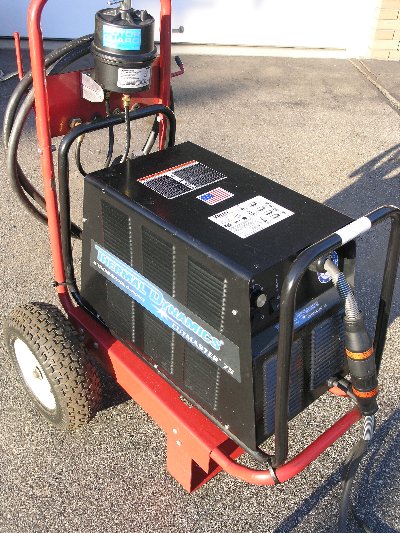
.
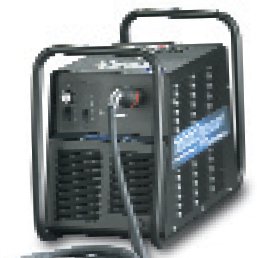
Are these two machines indeed the same under the covers ?.
Reply:They are very different power supplies. The CM 75 was a high frequency pilot. The CM 81 eliminated the HF. The SL 60 on the CM 75 is a retro-fit, not the original torch, although SL 60 is designed to work with either type of pilot system. The pcb and power supply design are completely different between the 2 machines, although the output characteristics were similar.
Reply:Thank you for the reply.

Originally Posted by mlinehan

The CM 75 was a high frequency pilot. The CM 81 eliminated the HF.
Reply:The original toch on the CM 75 was the PCH-102. That torch was hard wired into the front panel.WIth the SL 60, it is possible to add the quick disconnect. That part would be 7-5207, the quick disconnect on a short hose. That part can be fitted to a large number of plasma machines that originally did not have a quick disconnect.Capacitive Discharge is the method used to produce the HF is a CM 75. CD has some advantages as compared to older HF methods that used an HF transformer. CD is cheaper, lighter and has a smoother wave form, making for longer electrode life. As a piece of physics, CD start is not the same as HF start, but that is how we commonly refer to it.The CM 81 uses a blow apart torch. Air pressure causes the start cartridge to separate from the inside of the tip when the trigger is pressed. This separation draws an arc, igniting the pilot. This way we can eliminate the requirement for an HF spark to ignite the pilot arc. Eliminating the HF has advantages in terms of electrode life and HF noise emanations which can interfere with other electrical equipment. HF start has advantages in reliability and strength of the pilot. HF start is still the best way to start the larger, liquid-cooled torches used with expensive CNC equipment.If you want to compare the CM 75 to the CM 81, take a look at the schematic drawings. They have very different designs. For the guy who cuts with a hand torch, the CM 75 with SL 60 is very similar to the CM 81. What you care about is that the thing works when you press the trigger. The power suppplies are 2 different animals under the wrapper, however.
Reply:Thank you for the follow-up reply.
Originally Posted by mlinehan
The original torch on the CM 75 was the PCH-102. That torch was hard wired into the front panel.
Reply:Hello Eddy i have the same machine cant u help with a cap value |
|



 发表于 2022-11-22 15:51:06